Strategic Position Paper
Liverpool, Jevons, and the Civic Data Economy
Positioning Liverpool City Region as a global leader in data innovation. From the port ledgers that shaped industrial economics to the AI systems that will define the next century of growth.
The Liverpool Origins of Modern Economics
William Stanley Jevons was born in Liverpool on 1 September 1835, the ninth of eleven children. His father, Thomas Jevons, was an iron merchant. His maternal grandfather was William Roscoe, the Liverpool banker, historian, botanist, and abolitionist who financed the campaign against the slave trade.
Liverpool in the mid-nineteenth century was one of the most advanced industrial and trading systems in the world. Its port handled a significant proportion of global maritime commerce. The city functioned as a proto-data economy: structured information flows governed every aspect of trade, from cargo manifests and insurance underwriting to commodity pricing and customs reporting.
It was within this environment of quantification and system-level thinking that Jevons developed foundational ideas in economics, statistics, and formal logic. His work on marginal utility, published in The Theory of Political Economy (1871), helped launch the neoclassical revolution. His Principles of Science (1874) advanced the theory of scientific inference. And his invention of the "logic piano" in 1870, a mechanical reasoning device exhibited to the Royal Society, anticipated the computational logic that underpins modern computing.
But it is his 1865 work, The Coal Question, that carries the most direct relevance to the present day.
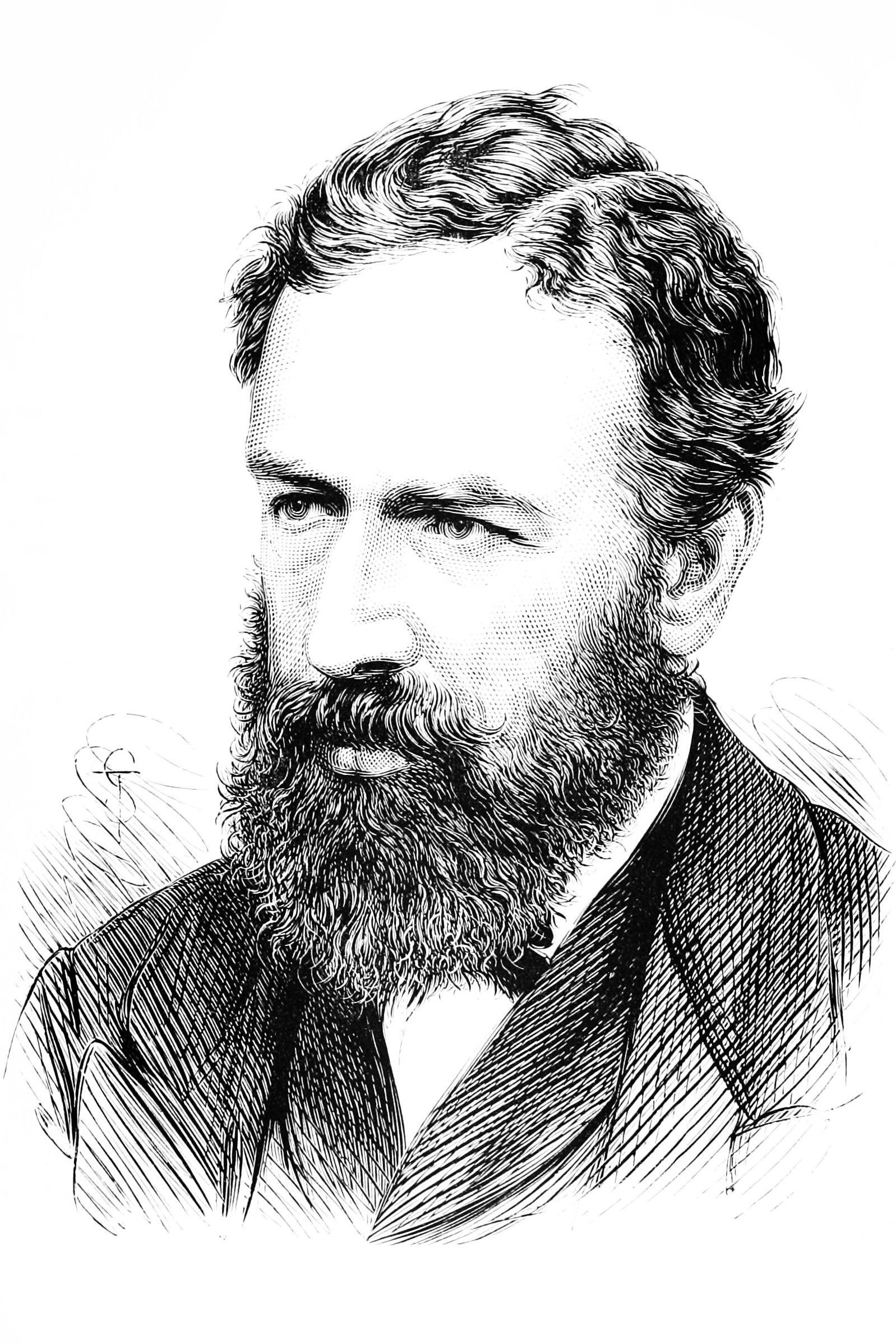
William Stanley Jevons (1835-1882). Engraving from Popular Science Monthly, 1877. Born in Liverpool, grandson of William Roscoe.
The Jevons Paradox: Then and Now
In The Coal Question, Jevons observed that improvements in the efficiency of steam engines did not reduce Britain's consumption of coal. Instead, they increased it. More efficient engines made coal-powered processes cheaper, which expanded their use across more industries and applications. Efficiency drove demand upward, not downward.
This insight, now known as the Jevons Paradox, provides a critical lens for understanding the modern AI economy.
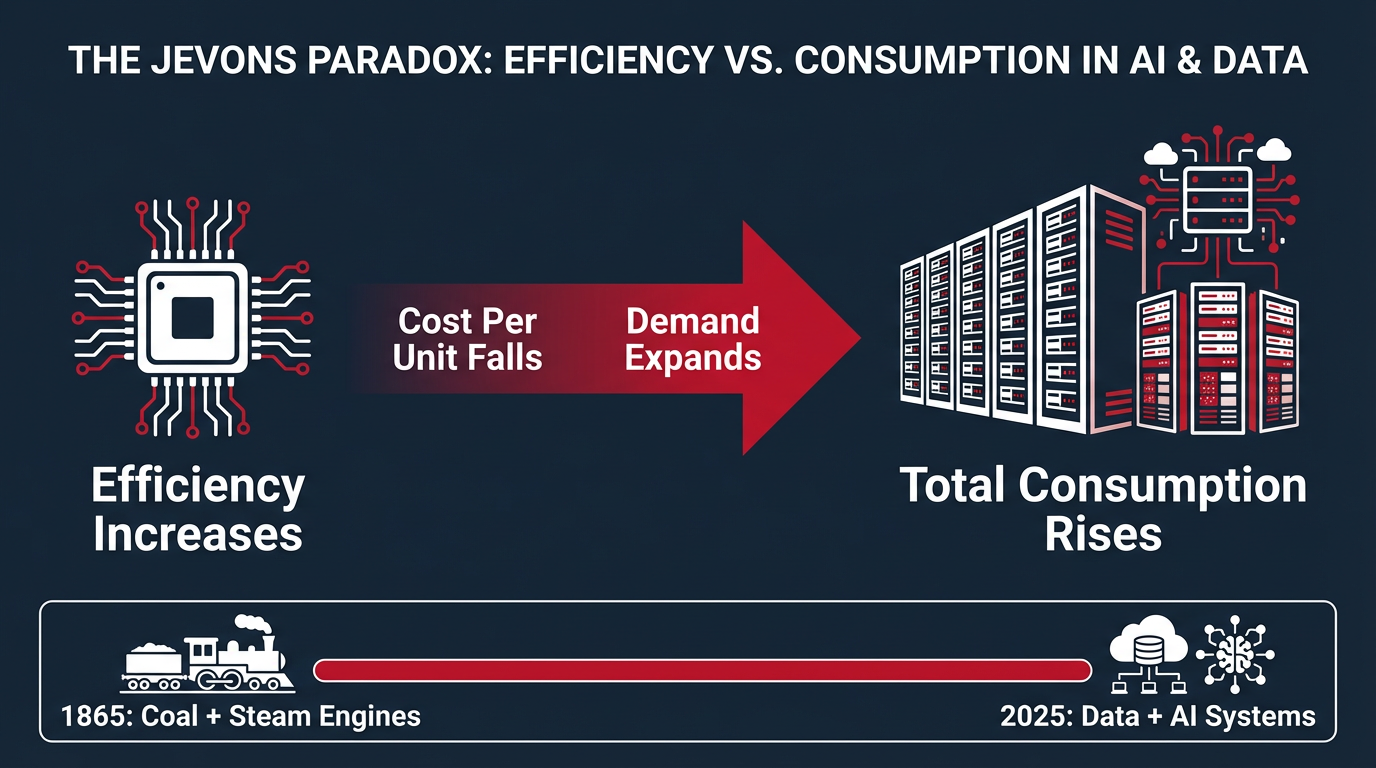
As AI systems become more efficient, the cost per computation falls. But rather than stabilising demand, this drives accelerating consumption of compute infrastructure, high-quality datasets, and energy. Microsoft CEO Satya Nadella explicitly invoked the Jevons Paradox in February 2025 when discussing why more efficient AI models will increase, not decrease, total infrastructure demand.
Research published by Northeastern University, NPR, and in academic papers on arXiv confirms this dynamic: AI efficiency gains trigger "rebound effects" where lower costs for AI services encourage more widespread and intensive use, increasing overall demand for computational resources, energy, and data.
Cities that can structure, govern, and supply trusted data at scale will become foundational to this growth. Liverpool's historical connection to Jevons is therefore not symbolic. It is structurally relevant.
From Industrial Data to Digital Data
Nineteenth-century Liverpool operated as a proto-data economy. Its port system relied on structured information flows that enabled risk management, capital allocation, and coordination across global trade networks.
Liverpool Port Data Systems (19th Century)
Shipping and Cargo Records
Structured manifests tracking every vessel, its cargo, origin, and destination across global trade routes.
Insurance and Financial Ledgers
Lloyd's of London began as a coffee house; Liverpool's underwriters built comparable risk quantification systems for maritime trade.
Commodity Pricing Systems
The Liverpool Cotton Exchange set global prices. Real-time information flows determined the value of goods across continents.
Customs Reporting Frameworks
One of the world's busiest ports required systematic customs data to manage revenue, tariffs, and regulatory compliance.
Maritime Logistics Tracking
Dock scheduling, warehouse allocation, and freight coordination demanded structured information at industrial scale.
Liverpool City Region Data Systems (Today)
Transport and Mobility
Merseyrail, bus networks, cycling infrastructure, and the Mersey Gateway all generate continuous operational data.
Healthcare and Public Services
NHS trusts, GP networks, social care, and the Liverpool School of Tropical Medicine produce substantial health datasets.
Energy and Utilities
Smart meters, grid management, and the Mersey tidal energy potential generate energy system data at scale.
Housing and Planning
Urban regeneration, planning applications, and housing data across the six local authorities of the city region.
Environmental Monitoring
Air quality, water quality, flood risk, and climate adaptation data across the Liverpool City Region.
This data remains largely underutilised as an economic resource. The concept of Civic Data as an Asset reframes these datasets as infrastructure, capable of generating value when structured, governed, and deployed effectively.
Isle of Man Partnership
The Data Asset Foundation Model
The Data Asset Foundation model, being developed by Digital Isle of Man in partnership with the EDM Association, provides a formal governance architecture for treating data as an economic asset class. It is the world's first legal framework of its kind.
Data as a Recognised Asset
Structured data is treated as a measurable, registrable asset with formal ownership, provenance, and usage rights.
Trusted Governance
A governance framework hard-coded into law, with dedicated data stewards and statutory registers ensuring accountability.
Multi-Party Participation
Secure frameworks enabling public, private, and citizen participation in data ecosystems without compromising privacy.
Responsible Monetisation
Mechanisms for valuation, balance sheet recognition, and collateral use, all within ethical and regulatory boundaries.
Transparency and Public Benefit
All operations comply with GDPR and data protection law. Personal data is never shared without explicit legal consent.
The Liverpool and Isle of Man Dual-Scale Model
Isle of Man
Regulatory and governance laboratory. A controlled national-scale testbed where Data Asset Foundations are being piloted under new legislation, with a statutory Data Asset Register and certified data stewards.
Liverpool City Region
Urban deployment and scaling environment. A metropolitan-scale platform with the population, institutional depth, and sectoral diversity to demonstrate real-world impact across health, transport, energy, and commerce.
Together, they can establish the first cross-border Civic Data Economy corridor in Europe.
View the Liverpool Isle of Man CorridorLiverpool as a Civic Data Innovation Hub
Liverpool City Region possesses a distinctive combination of assets that position it to function as a civic data platform city.
Historical Positioning
A unique intellectual lineage linking industrial infrastructure, measurement systems, and Jevons' economic theory provides a compelling strategic narrative that no other city can claim.
Jevons was born in Liverpool in 1835. His grandfather was William Roscoe, the Liverpool banker, historian, and abolitionist. The city shaped his thinking.
Academic Capability
The University of Liverpool, Liverpool John Moores University, and the Liverpool School of Tropical Medicine provide strong foundations in data science, AI, and applied research.
The University of Liverpool's computer science department is highly rated for research. The Hartree Centre at Sci-Tech Daresbury provides supercomputing capability.
Public Sector Data Infrastructure
The Liverpool City Region Combined Authority operates extensive data-generating systems across transport, health, planning, environment, and economic development.
LCR Connect provides 212km of full-fibre, gigabit-capable network infrastructure. The region is developing the UK's largest 5G mesh network.
Private Sector Alignment
Key sectors including maritime logistics, digital health, advanced manufacturing, urban mobility, and climate technologies are increasingly dependent on high-quality data and AI.
Liverpool's digital economy has grown 48% over the last decade, surpassing the UK average of 29%. Digital productivity has increased by 57%.

The University of Liverpool's investment in digital research infrastructure forms part of the Knowledge Quarter's growing innovation ecosystem.
Economic Context: The Evidence Base
The following figures are drawn from published government statistics, Combined Authority reports, and market research. They represent the investment environment into which a Civic Data Asset strategy would operate.
£10bn
LCR Growth Plan Target
addition to Liverpool City Region economy over 10 years
Source: Liverpool City Region Combined Authority Growth Plan, 2025£2bn
LCR Investment Fund
to accelerate growth, jobs, and development
Source: Liverpool City Region Combined Authority, 2025£800m
Life Sciences Innovation Zone
public and private investment, generating 8,000 skilled jobs
Source: Invest Liverpool City Region$43bn
UK Data Centre Market
projected UK data centre market value by 2030 (from $18bn in 2024)
Source: NextMSC Market Research, 2025£10m
Civic HealthTech Zone
for data and AI-powered health innovation, creating 365 jobs
Source: Liverpool City Region Combined Authority, 2024£62.4bn
UK IT and Software Services
GVA contribution to UK economy, growing 8.7% year on year
Source: DCMS Economic Estimates, 2024Note on methodology: These are published figures from the sources cited. They represent targets, market projections, and reported statistics, not Liverpool International's own estimates. The potential economic impact of a dedicated Civic Data Asset strategy layered on top of these existing commitments would require formal economic modelling by an independent research body.
Strategic Urgency: The Jevons Framework
Jevons' insight is central to understanding why action is required now, not later.
As AI systems become more efficient, cost per computation falls. Accessibility increases. Applications expand into new domains. The result is accelerating total demand for compute infrastructure, high-quality datasets, and energy systems. This is a direct manifestation of the Jevons Paradox in the AI era.
The International Energy Agency projects that electricity demand from data centres could more than double by 2026, surpassing Canada's national power consumption. AI data centres consume vast quantities of water for cooling. The production of AI hardware requires rare earth minerals.
Cities that can structure, govern, and supply trusted data at scale will become foundational nodes in this expanding economy. Those that cannot will be consumers of AI services built elsewhere, on terms set by others.
Liverpool's historical connection to Jevons is not decorative heritage. It is a strategic asset. The city that produced the thinker who first identified this dynamic is uniquely positioned to interpret and act on it.
Connected Threads
This narrative connects to multiple dimensions of Liverpool's story. Explore the threads below.
Building the Systems That Power the Data Economy
In the nineteenth century, Liverpool built the systems that powered industrial expansion: the docks, the railways, the insurance markets, the information networks.
In the twenty-first century, it can build the systems that power the data economy: the governance frameworks, the trusted data infrastructure, the civic platforms that enable AI to serve public benefit.
The city that shaped the thinker who first understood this dynamic is the city best placed to act on it.